In Search of Jang Bogo's Successors | Korea University Maritime Law Re…
페이지 정보

본문
In Search of Jang Bogo's Successors | Korea University Maritime Law Research Center | A Bridgehead for Upholding Maritime Law and Expanding Its Foundation
165 Sessions of “Ocean Society” Continue Post-COVID
Research Expands to Cover Ports, Logistics, Shipbuilding, Fisheries, and Other Maritime-Related Fields
Coastal shipping also plays a significant role in domestic transportation and logistics. This is why maritime law is addressed in the fifth section of the Korean Commercial Code, following the fourth section on "Companies." The sixth section deals with "Air Transport."
Maritime law covers legal issues related to vessel operations. While countries like the U.S., Japan, and the U.K. have standalone laws called the International Carriage of Goods by Sea Act, Korea includes maritime law in the fifth section of its Commercial Code.
However, the status of maritime law in Korea has been steadily declining.
On the 8th, Professor Emeritus Kim In-Hyun from Korea University’s School of Law remarked, "Up until the 1970s, maritime law was considered an important field in legal studies, but the situation has become challenging recently." He added, "Currently, Korea University is the only law school in Seoul offering a course on maritime law."
The Establishment of the Korea University Maritime Law Research Center
Amid this trend, the Korea University Maritime Law Research Center was established. It was spearheaded by Professor Kim, a former ship captain, who took on the role of director in 2009 under the Korea University Legal Research Institute. The center comprises one research professor and two research assistants.
The center conducts research on maritime law, introduces academic papers, organizes professional courses on maritime law, and engages in activities such as the "East Asia Maritime Law Forum," "Policy Research Group on Shipbuilding and Financial Law," and the "Forum on Stabilizing Maritime, Shipbuilding, and Logistics Industries."
On October 26, the center hosted a workshop on understanding the offshore wind power industry, supported by companies such as Namseong Shipping, J-Eco, and Yooil Heavy Industries, continuing its research into emerging industrial trends.
In 2020, as the COVID-19 pandemic began, the center launched an online program called “Ocean Society” As of December 7, 2024, it has hosted 165 lectures.
Sharing Maritime Law Trends among Korea, China, and Japan
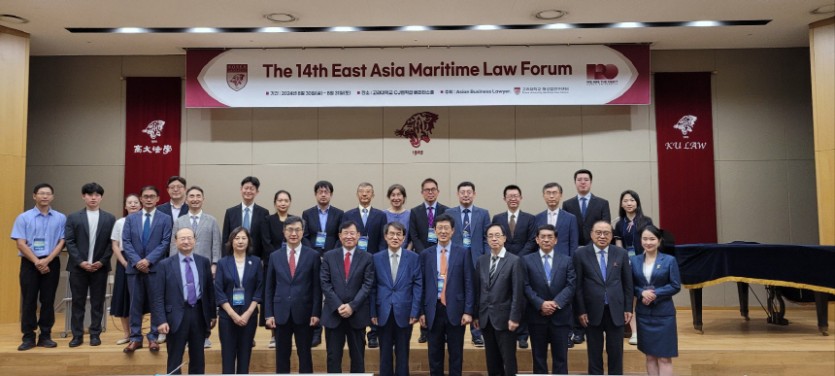
On October 30-31, the center held the 14th East Asia Maritime Law Forum at Korea University’s CJ Law Hall. Scholars and attorneys from Korea, China, and Japan discussed recent trends in maritime law, digital transformation, decarbonization in the shipping industry, and the legal implications of these changes.
The forum, initiated in 2008 by Korea University, Waseda University in Japan, and Dalian Maritime University in China, began with an opening speech by Hwang Yi, Dean of Korea University's Law School. Welcome addresses were delivered by Zhou Zhuxian, President of Dalian Maritime University, Justice Roh Tae-ak of Korea’s Supreme Court, and Kwon Sung-won, President of the Korean Maritime Law Association. All speakers emphasized the growing significance of maritime transportation in East Asia's global trade and highlighted the forum's importance as a platform for collaboration among scholars and attorneys in the region.
On the first day, Professor James Hu from Shanghai Maritime University presented on the revision process and future outlook of China’s maritime law. He underscored the need for modernizing the law governing the carriage of goods by sea, establishing a compensation framework for marine pollution caused by vessels, raising liability limits, and introducing provisions for the liability concerning passenger injury or death.
Japanese attorney Shuji Yamaguchi reviewed the 16-year history of the East Asia Maritime Law Forum and explained the revision process of Japan’s maritime law. He noted that Japan’s amendment to include electronic bills of lading aligns with the United Nations Commission on International Trade Law (UNCITRAL) Model Law on Electronic Transferable Records.
China’s proposed maritime law revisions, particularly those addressing ship ownership, specify that ownership of a vessel under construction is determined by contract. In the absence of a contract, ownership belongs to the shipyard.
The center noted the trend of expanding the scope of China’s maritime law to include areas such as coastal and inland waterway transportation, which were previously excluded.
Li Anjun, an attorney from a Hong Kong law firm, presented recent developments in Hong Kong maritime case law. Professor Kim discussed significant maritime law precedents in Korea.
On the second day, discussions focused on digital transformation, decarbonization in the shipping industry, and their legal implications.
Professor Kim delivered a presentation titled “Legal Implications of Unmanned Ships and Korean Maritime Law,” exploring the legal challenges posed by the commercialization of autonomous ships and suggesting necessary revisions.
Dr. Hyun-Kyun Lee addressed civil law issues related to decarbonization, stating that the cost of supplying low-emission ship fuel should be borne by the time charterer, while the installation of new equipment is the responsibility of the shipowner.
Contributions Across Legislative, Judicial, Executive, and Academic Sectors
In October 2020, during the COVID-19 pandemic, the center launched an online program titled “Ocean Society on Maritime Affairs.” According to Professor Kim, “I realized that using online platforms could help overcome time and space constraints, allowing for a broader exchange of knowledge and information about the maritime industry.” Initially starting with 20 guest speakers and 30 members, the group has grown to 980 members.
To systematize these discussions, the center decided to establish the study group as an incorporated association, holding its inaugural general meeting on July 25, 2024.
On December 7, the 165th session of “Conversations with Authors and Experts on Maritime Affairs” featured a presentation by Im Do-hyung, CEO of Avikus, on autonomous ships, followed by member discussions. Approximately 80 participants joined the Zoom session for this interactive debate.